A few words from the filmmaker: I wrote this movie asking myself a few questions. If I could meet my grandmother again, what would I say? What would I ask her first? Would we understand each other?
There are many things I wish I could tell my grandmother today. This film allowed me to speak to her in many ways.
It’s bringing to eternal life two things: the feelings I had when I first went to Palestine. And those feelings are how I wrote this film. While imagining talking to my grandmother again, in the form of meeting her when she was my age.
Secondly, it is about truth. In a world full of victimhood complexities, where what used to be real has been deformed into polished and deodorized manipulative skits, the truth is often difficult to find. You are probably wondering, how does one find truth in a film that involves time travel and fictional depiction of a time that no longer exists? The answer to that is, truth can be found in the method of filmmaking, not within the story itself.
This film is built off of truth and rich history. Behind this film are piles of personal stories, family histories, settler-colonial history, and folkloric Palestinian oral stories that existed pre-1948. As part of the diaspora, grandparents and elders serve as a direct line to Palestine. With that generation disappearing, a new, stronger connection is being developed. Behind that connection exists a flourishing fusion of oral histories, family relics, embroidery, epigenetics, and traditions, essentially everything behind an indigenous existence that is adapting to its modern surroundings.
This film is an embodiment of the regeneration that is occurring presently to Palestinians in the diaspora. Theoretically, it fuses the past with the present, which dictates the future. Physically, and in a nonfiction sense, the making of this film required five young Palestinian women of the diaspora to return to their homeland, including myself. My great-grandmother’s headdress (Oqay) was worn by the character playing the great-grandmother. This process felt reflexive, as if we all stepped into the role of “The Lost One” while making this film.
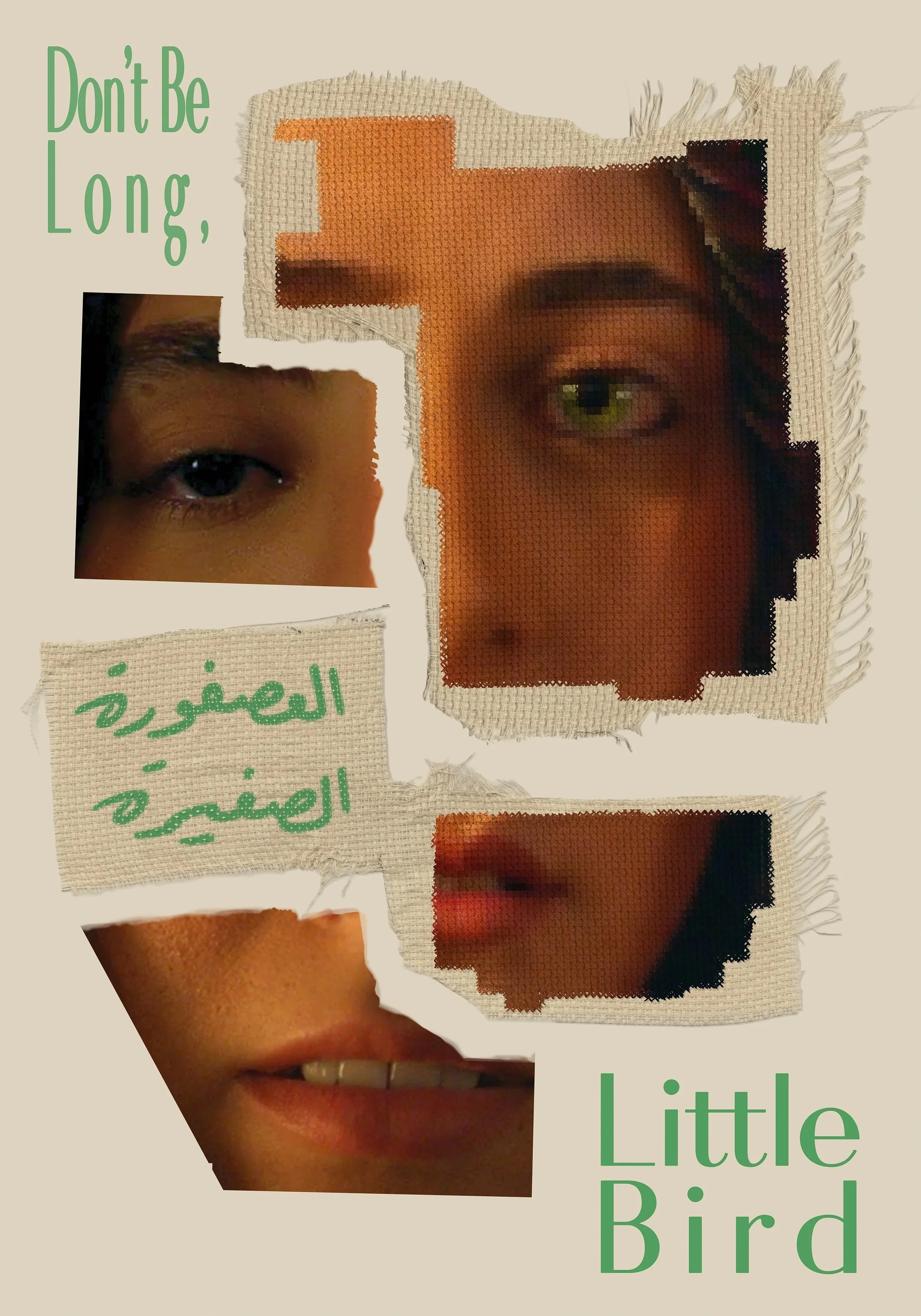
Another important element of the diaspora’s rebirth is identifying that Palestinian women, historically and presently, are not victims. The “The Little Bird” is the title of a Palestinian folktale from the published collection “Speak Bird, Speak Again” by scholars Ibrahim Muhawi and Sharif Kanaana. The tales are collected from a group of seventeen tellers, all householders and majority housewives who can neither read nor write. Palestinian folktale is primarily a woman’s art, and women at that time provided a large measure of creative artistic energy. The story of “The Little Bird” depicts courtship and female sexuality through the metaphorical body of a bird, who while being hunted and shot down (courted by a man) is where the procreative power of her being, her creativity and playfulness, is found from within.
As the folk-tellers of Palestine say,
This is my tale, I’ve told it, and in your hands I leave it.
About the film
A UCLA MFA Thesis film, with the support of the Palestinian community of Southern California, this adventure short “Don’t Be Long, Little Bird” unites American-born teen, Rima the Lost One (Banna Bazzarie) with her great-grandmother, also named Rima (Muna Basha), on a time-travel journey to 1930s Palestine. After clashing with her modern-ish Mom on vacation, Rima the Lost One finds herself warped through a portal that takes her to the present of her ancestors. Rima the Lost One must navigate her ancestral homeland, a place she’s never known. She desperately looks for a way home, aka the present, the place she originally desired to escape from.
Written and directed by Reem Jubran, a recent MFA graduate from UCLA in Directing and winner of the Gotham Awards Student Showcase sponsored by Focus Features. “Don’t Be Long, Little Bird” is produced by Dina Saba, Nadeen Jubran, Fadi Saba and Ahmad Cory Jubran, and features music by the all-female Palestinian A capella group, Istiwanat.
The film features first-time actor Banna Bazzarie and Palestinian stars Muna Basha and Clara Khoury.
